29.4V 2.5A AC Charger for 24V / 25.2V Lithium-Ion Batteries
The BiXPower ACC-24235 is a dedicated
AC battery charger designed for compatible
24V / 25.2V (7S) lithium-ion rechargeable
battery packs. It provides controlled
charging with a maximum output voltage of
29.4V and a maximum charging current
of 2.5A.
Unlike a conventional laptop power adapter,
this charger is designed to manage the
battery charging process using a
constant-current / constant-voltage
(CC/CV) charging profile.
29.4V Maximum Voltage
2.5A Maximum Current
7S Lithium-Ion Batteries
CC/CV Charging
LED Status Indicator
100–240V AC Input
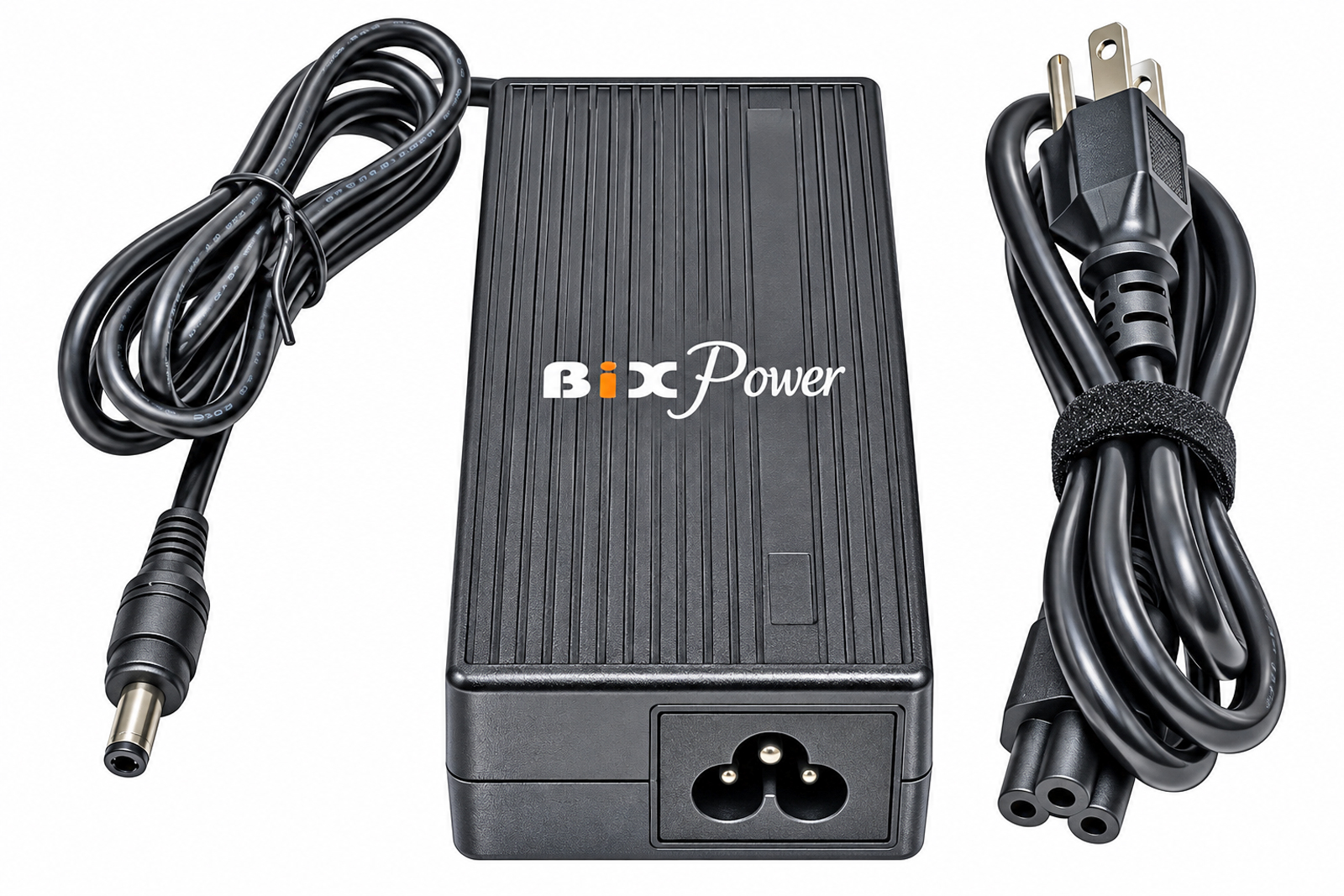 BiXPower ACC-24235 AC lithium-ion battery charger
Key Features
-
Designed for 7S lithium-ion batteries:
Suitable for compatible 24V / 25.2V nominal
battery packs requiring a 29.4V charging voltage.
-
Controlled charging current:
Limits charging current to a maximum of 2.5A.
-
CC/CV charging method:
Helps provide appropriate charging voltage
and current throughout the charging process.
-
LED charging status:
Red indicates charging current above 300mA;
green indicates current at or below 300mA.
-
Universal AC input:
Accepts 100–240V AC, suitable for use with
compatible power cords in many countries.
-
Compact design:
Convenient for home, office, workshop,
and other indoor charging applications.
Compatible Batteries
The ACC-24235 is intended for compatible
7-series-cell lithium-ion battery packs
that require a 29.4V final charging voltage
and permit a charging current of up to 2.5A.
Compatible BiXPower battery models may include:
- BiXPower BX2488
- BiXPower BX2487
- BiXPower BX2493
- BiXPower BX2499
- Other compatible 24V / 25.2V 7S lithium-ion battery packs
Important compatibility information:
Not every battery labeled "24V" uses the
same chemistry or charging voltage.
Before connecting the charger, verify
the battery's required charging voltage,
maximum permitted charging current,
connector dimensions, polarity,
and charging-system compatibility.
Do not use this charger for incompatible
LiFePO4, lead-acid, or other battery chemistries.
Output Connector
The charger is equipped with a DC barrel
output connector with the following dimensions:
- Outside diameter: 5.5mm
- Inside diameter: 2.5mm
Confirm the required polarity from the
charger label and battery specifications
before connecting. Matching connector
dimensions alone does not guarantee compatibility.
LED Charging Status
The ACC-24235 includes an LED indicator
to help identify charging status.
| LED Indicator |
Meaning |
| Red |
Output current is greater than 300mA,
indicating active battery charging.
|
| Green |
Output current is 300mA or less,
normally indicating charging is nearly
complete or complete.
|
A green LED by itself does not always
confirm a fully charged battery. It may
also appear when the charger is disconnected
or the battery is not accepting charging
current. Follow the battery manufacturer's
instructions to confirm charging completion.
Battery Charger vs. Laptop AC Power Adapter
A lithium-ion battery charger may look
very similar to a laptop AC-to-DC power
adapter. Both convert household AC power
into DC power, but their output behavior
and intended applications are different.
Lithium-Ion Battery Charger: Controlled Current and Voltage
A properly designed lithium-ion battery
charger controls both charging current
and charging voltage according to the
battery's charging requirements.
For most conventional lithium-ion battery
packs, charging uses a
constant-current / constant-voltage
(CC/CV) process:
-
Constant-current stage:
The charger supplies a controlled charging
current, up to its rated maximum.
Its output voltage rises as the battery
voltage increases.
-
Constant-voltage stage:
When the battery approaches its specified
final charging voltage, the charger
maintains that voltage while charging
current gradually decreases.
-
Charge completion:
When charging current falls below the
charger's termination threshold,
charging is considered complete.
The charger's rated output current is
its maximum controlled charging
current, not necessarily the current
delivered throughout the entire charging cycle.
Laptop AC-to-DC Power Adapter: Constant Voltage
A conventional laptop AC power adapter
is designed to provide a
constant DC output voltage,
such as 19V, 20V, or 24V.
Its output current varies according to
the connected device's power demand,
up to the adapter's rated output capacity.
For example, a 24V 5A power adapter
maintains approximately 24V while
a connected device may draw 1A, 2A,
or 5A depending on its operating needs.
The 5A rating is the adapter's maximum
output current, not a fixed output current.
Comparison: Battery Charger vs. Power Adapter
| Feature |
Lithium Battery Charger |
Laptop Power Adapter |
| Primary Purpose |
Recharge compatible battery packs |
Power electronic devices |
| Output Voltage |
Varies during CC stage; held at final voltage during CV stage |
Normally remains constant |
| Output Current |
Controlled according to charging profile |
Varies with device demand |
| Current Rating |
Maximum charging current |
Maximum available output current |
| Charge Termination |
Designed to end or manage charging |
Normally no battery-specific charge termination |
| Direct Battery Charging |
Only with compatible battery packs |
Only through a suitable internal or external charge controller |
Why You Should Not Use a Regular Laptop Adapter to Charge an Unprotected Battery Pack
Lithium-ion battery cells have relatively
low internal resistance. When connected
directly to a constant-voltage power source
without proper charging control, they may
draw excessive current.
A conventional AC power adapter is
generally designed to maintain its
rated voltage while supplying whatever
current the load requires, within the
adapter's capabilities.
Without an appropriate battery charging
controller, excessive charging current
may cause:
- Battery overheating
- Accelerated battery cell degradation
- Damage to battery cells
- Power adapter overload or shutdown
- Damage to the adapter or charging connections
- In severe cases, thermal runaway or fire
Safety warning:
Never connect a conventional constant-voltage
power adapter directly to lithium-ion cells
or a battery pack that lacks a suitable
charging controller. A battery protection
circuit or BMS alone does not necessarily
provide the current regulation and charge
termination required for safe charging.
When Can a Laptop Power Adapter Charge a Lithium Battery?
Some rechargeable battery packs include
a built-in charging controller
that manages the voltage and current
delivered to the battery cells.
For example, certain BiXPower battery
models, including the
BP90, BP100, BP220, and BP300,
incorporate internal charging control
and can accept compatible external
DC power sources.
For these batteries, a suitable
constant-voltage AC-to-DC power adapter
may be used for charging, provided that:
-
The adapter output voltage is within
the battery's specified charging input range.
-
The adapter provides sufficient output
power for the battery's charging requirements.
-
The connector size and polarity are correct.
-
The battery model explicitly supports
charging from that type of DC power source.
Helpful tip:
If a rechargeable battery is specified
to accept a wide range of DC charging
input voltages, it generally indicates
that the battery has an internal
charging controller or power conversion
circuit that manages the charging process.
Always verify this capability in the
battery's official specifications.
The external adapter must still be
compatible with the battery's input
requirements. A higher-wattage adapter
does not automatically force additional
current into a battery with properly
designed internal charging control.
Why Charging Current Matters for Battery Life
Lithium-ion battery cells generally
benefit from charging within their
manufacturer-specified current limits.
Moderate charging currents often help
reduce heat and battery stress.
Faster charging can be convenient, but
higher charging currents may increase
cell temperature and accelerate long-term
capacity degradation.
Charging beyond the battery cells'
permitted current range may cause
overheating, premature aging, or
permanent damage.
Benefits of Moderate Charging Current
- Helps reduce heat generation
- May extend battery cycle life
- Reduces charging stress on battery cells
- Supports reliable long-term performance
The ACC-24235 provides a maximum
charging current of 2.5A, making it
suitable for compatible battery packs
whose recommended charging current
allows this level.
Charging time depends on battery
capacity, state of charge, temperature,
charging efficiency, and the duration
of the constant-voltage charging stage.
Technical Specifications
| Product Model |
ACC-24235 |
| Product Type |
AC-to-DC Lithium-Ion Battery Charger |
| Compatible Battery |
24V / 25.2V nominal 7S lithium-ion |
| AC Input |
100–240V AC |
| Input Frequency |
47–63Hz |
| Maximum Output Voltage |
29.4V DC |
| Maximum Charging Current |
2.5A |
| Maximum Rated Output Power |
73.5W |
| Charging Method |
Constant Current / Constant Voltage (CC/CV) |
| Output Connector |
5.5mm OD x 2.5mm ID barrel connector |
| LED Indicator |
Red: >300mA; Green: ≤300mA |
| Dimensions |
Approximately 140 x 60 x 32mm |
| Weight |
Approximately 0.75 lb |
| Certifications |
UL / CE claimed; verify markings on actual unit |
| Warranty |
1 Year Limited Warranty |
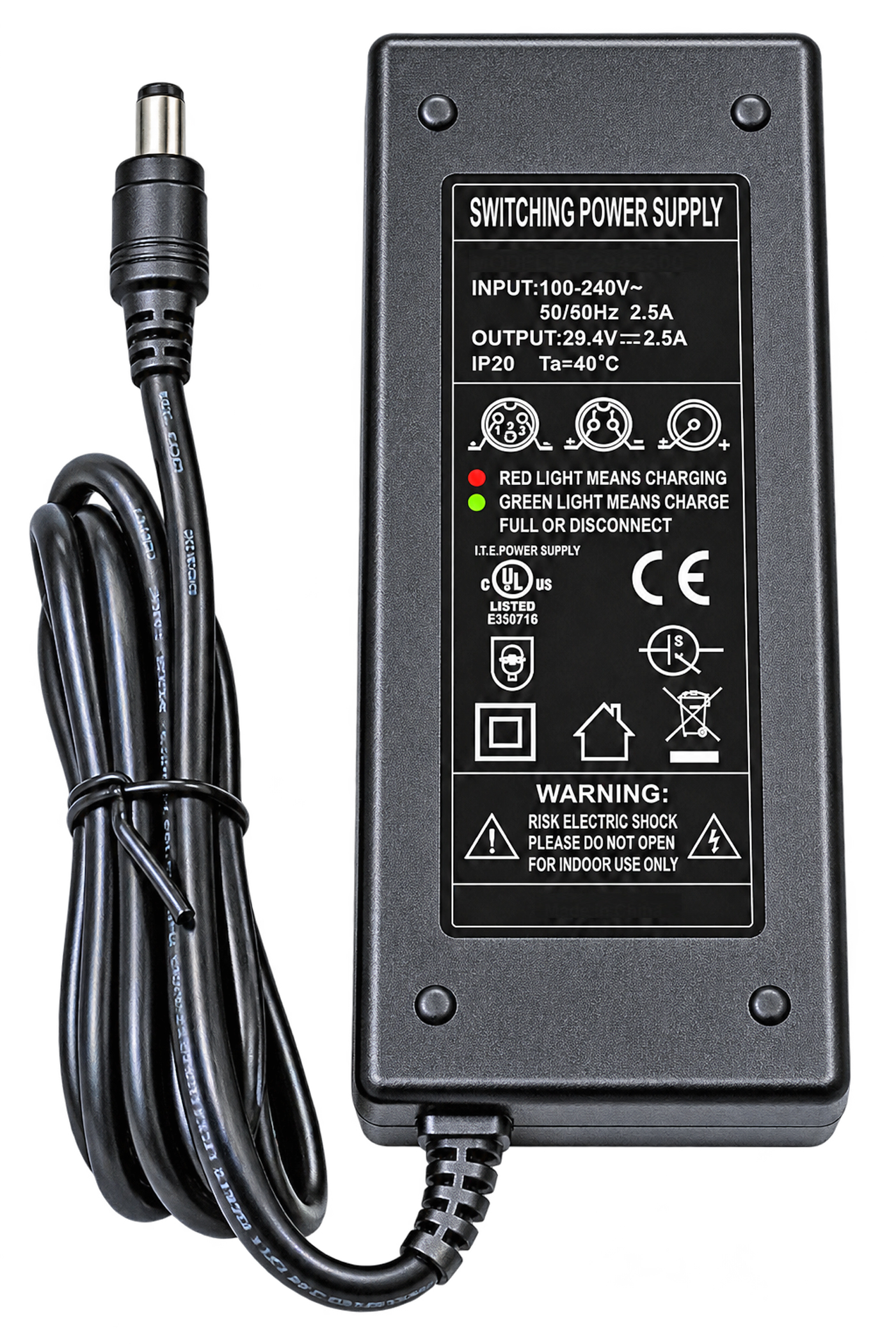
How to Charge Your Lithium-Ion Battery
-
Verify that the battery requires a
29.4V CC/CV charger and supports
charging current up to 2.5A.
-
Check the battery charging port,
connector size, and polarity.
-
Connect the charger DC output
to the compatible battery charging port.
-
Connect the charger to a suitable
100–240V AC power outlet.
-
Observe the charging status indicator.
-
When charging is complete,
disconnect the charger according
to the battery manufacturer's instructions.
Charge batteries in a dry, ventilated
area away from flammable materials.
Do not charge damaged, swollen,
overheated, or otherwise abnormal batteries.
Frequently Asked Questions
Can I use this charger for any 24V lithium battery?
No. The battery must require a 29.4V
final charging voltage and support
a maximum charging current of 2.5A.
The connector and polarity must also match.
Different lithium battery chemistries
may require different charging voltages.
Is a lithium-ion battery charger the same as a laptop power adapter?
No. A dedicated lithium-ion charger
controls charging current and voltage
according to a charging profile.
A conventional laptop adapter generally
supplies a constant output voltage,
with current determined by the load.
Can I use a laptop power adapter to charge a lithium-ion battery?
Only if the battery includes a suitable
charging controller and explicitly supports
the adapter's voltage, power rating,
connector, and polarity.
Never connect an ordinary laptop adapter
directly to lithium-ion cells without
appropriate charging control.
Does a 2.5A charger always deliver 2.5A?
No. The 2.5A rating is the maximum
controlled charging current.
During the constant-voltage stage,
charging current normally decreases
as the battery approaches full charge.
Will slower charging help extend battery life?
Charging at a moderate current within
the battery manufacturer's specifications
can reduce heat and cell stress.
This may help preserve long-term
battery capacity and cycle life.
What does the green LED mean?
The green LED indicates that the
charger output current is 300mA
or less. This normally occurs near
the end of charging, but may also
occur when no charging current is flowing.
Package Contents
- 1 x BiXPower ACC-24235 AC Battery Charger
- 1 x Compatible AC Power Cord
BiXPower Technical Support
Not sure which charger is right for
your rechargeable battery?
Contact BiXPower with your battery
model number, charging voltage,
connector dimensions, and polarity
so we can help you identify a
compatible charging solution.




