36V Lithium-Ion Battery DC-to-DC Charger – 42V 2A
Convert a compatible DC power supply into a
36V lithium-ion battery charger.
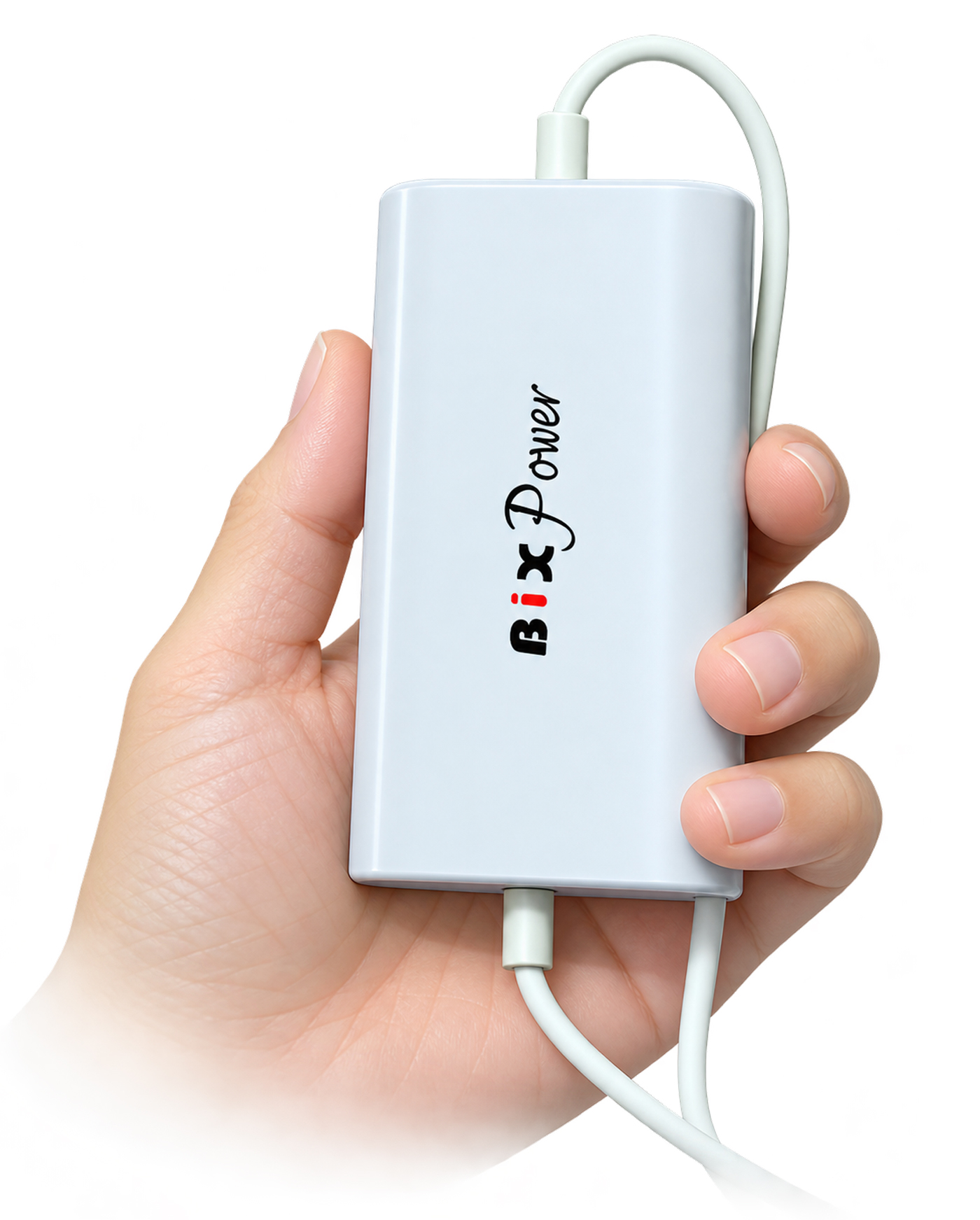
The BiXPower DCC-36V2A converts DC input power
from 9V to 32V into a controlled charging output
of up to 42V and 2A for compatible 36V (10S)
lithium-ion battery packs.
Unlike an ordinary constant-voltage DC power adapter,
this compact DC-to-DC battery charger is designed
to regulate charging current and voltage according
to the requirements of compatible rechargeable
lithium-ion batteries.
It allows you to use a suitable DC power source,
such as a laptop AC-to-DC adapter, to charge
compatible 36V lithium-ion batteries without
requiring a dedicated AC battery charger.
Key Features
- Wide DC input voltage range: 9V to 32V
- Maximum charging output voltage: 42V DC
- Maximum charging current: 2A
- Designed for compatible 36V (10S)
lithium-ion batteries
- Converts constant-voltage DC power into
controlled battery-charging power
- Suitable for compatible laptop AC adapters
and other DC power sources
- Compact and lightweight design
- Red and green LED charging status indicator
- Built-in electrical protection features
- Automatic charging termination
How Does This DC-to-DC Battery Charger Work?
A standard laptop AC-to-DC power adapter
typically provides a constant output voltage,
such as 12V, 19V, 20V, or 24V.
The connected device determines how much
current it draws, up to the adapter's
maximum rated output current.
A lithium-ion battery charger works differently.
It must control both the charging current
and the charging voltage to meet the
battery's charging requirements.
The BiXPower DCC-36V2A converts a compatible
DC power supply into a controlled charging
source for 36V lithium-ion batteries.
Constant-Current / Constant-Voltage Charging
During the main charging stage, the charger
limits the charging current to a maximum of
2A while adjusting its output voltage
according to the battery's condition.
As the battery approaches full charge,
the charger limits the output voltage to
42V and the charging current gradually
decreases.
This charging method is commonly known as
constant-current / constant-voltage
(CC/CV) charging.
The charger is designed to terminate
charging output when the charging
process is complete.
Important Difference:
A regular laptop AC power adapter is not
automatically suitable for directly charging
a lithium-ion battery. The DCC-36V2A
provides the controlled voltage and current
needed to charge compatible 36V (10S)
lithium-ion battery packs.
Compatible 36V Lithium-Ion Batteries
This DC-to-DC charger is designed for
compatible 36V nominal lithium-ion
battery packs using 10 cells in series
(10S), with a maximum charging voltage
of 42V.
Compatible BiXPower models include:
- BiXPower BX3691 lithium-ion battery
- BiXPower BX3694 lithium-ion battery
- BiXPower BX3699 lithium-ion battery
- Other compatible 36V (10S) lithium-ion
batteries requiring 42V charging
Before using this charger, confirm that
your battery supports a maximum charging
voltage of 42V and a charging current
of up to 2A.
Also verify the charging connector
dimensions and polarity.
Battery Compatibility Notice:
This charger is designed for compatible
10S lithium-ion batteries.
It is not a universal charger for
every battery labeled 36V.
Do not use it with lead-acid, LiFePO4,
or other battery chemistries unless
their charging requirements have been
specifically verified as compatible.
Input and Output Connectors
The DCC-36V2A has separate DC input
and battery charging output connectors.
- Input Connector:
5.5 x 2.1mm female DC barrel connector
- Output Connector:
5.5 x 2.1mm male DC barrel connector
Although the input and output connectors
have the same nominal barrel dimensions,
they serve different purposes.
The input receives DC power while
the output delivers controlled charging
power to the battery.
Always verify connector polarity and
battery compatibility before connecting.
Use a Compatible Laptop AC Power Adapter
One of the main advantages of this
DC-to-DC charger is its ability to
operate from a compatible constant-voltage
DC power supply.
For example, a laptop AC adapter
providing 19V or 20V DC may be used
as the input power source if it meets
the charger's electrical requirements.
The DCC-36V2A converts that input
into a controlled charging output
of up to 42V for compatible 36V
lithium-ion batteries.
DC Power Supply Requirements
- Output voltage must be within
the charger's 9V–32V DC input range.
- Power adapter must have sufficient
wattage to support battery charging.
- Input connector must be compatible
with the 5.5 x 2.1mm female input.
- Input polarity must match the charger.
- The DC supply must provide stable,
properly regulated power.
Important: Input Power Requirement
90W–100W Input Power Recommended
for Full-Rate Charging
This charger can deliver up to
42V x 2A = 84 watts
of charging output.
The charger does not generate energy.
Because DC-to-DC power conversion
is not 100% efficient, the input
power supply must provide more
than 84W to support the maximum
rated charging output.
A DC power source capable of supplying
approximately 90W–100W
is recommended for full-rate charging.
A source with additional power capacity
provides useful operating margin.
If the input power source cannot
supply sufficient power, the charger
may not operate correctly, may shut
down, or may be unable to maintain
its rated charging output.
Examples of DC Power Sources
- 19V 5A laptop adapter:
95W rated output; potentially suitable
if connector, polarity, and other
requirements are met.
- 20V 5A laptop adapter:
100W rated output; potentially suitable
for full-rate charging.
- 24V 4A DC adapter:
96W rated output; potentially suitable
under appropriate operating conditions.
- 12V 5A DC adapter:
60W rated output; insufficient for
full-rate 84W charging output.
These examples are based on rated
electrical output power. Actual
compatibility depends on conversion
efficiency, voltage stability,
connector compatibility, and
operating conditions.
A higher-rated current capacity
does not force excessive current
into the charger. The charger
draws the input current required
by its operation, within the
capability of the power source.
Portable DC Power Applications
The wide DC input range allows
the DCC-36V2A to operate from
different compatible DC power
sources, making it useful for
portable and mobile charging
applications.
Possible applications include
charging compatible 36V battery
packs used in portable equipment,
mobility devices, and other
rechargeable battery systems.
Some USB-C Power Delivery power
sources may also be usable when
combined with an appropriate
USB-C PD trigger or conversion
accessory that provides a compatible
regulated DC output.
USB-C PD accessory reference image.
The charger does not have a native
USB-C input. Compatibility requires
a suitable conversion accessory
and sufficient available power.
USB-C Power Notice:
A 60W USB-C PD charger cannot
provide the 90W–100W input power
recommended for full-rate
42V 2A charging.
Do not assume that every USB-C
charger or cable is compatible.
How to Charge Your 36V Lithium-Ion Battery
-
Check battery compatibility.
Verify that the battery is a
compatible 36V (10S) lithium-ion
battery requiring 42V charging.
-
Verify the power source.
Confirm that the DC input voltage
is between 9V and 32V and that
the power supply has sufficient
output capacity.
-
Check connectors and polarity.
Make sure both input and output
connections are correct.
-
Connect the battery.
Connect the charger output to
the battery's charging port.
-
Connect DC input power.
Connect the compatible DC power
supply to the charger's input.
-
Observe the LED indicator.
The indicator normally turns red
during charging and green when
charging is complete.
-
Disconnect after charging.
When charging is finished,
disconnect the power source
and battery according to the
battery manufacturer's instructions.
LED Charging Status Indicator
- Red LED:
Battery charging is in progress.
- Green LED:
Charging has completed under
normal operating conditions.
If the charger behaves unexpectedly,
disconnect the input power and
check the battery, connectors,
and DC power source.
Technical Specifications
| Product Model |
DCC-36V2A |
| Product Type |
DC-to-DC lithium-ion battery charger |
| Input Voltage |
DC 9V–32V |
| Input Connector |
5.5 x 2.1mm female DC barrel connector |
| Battery Compatibility |
Compatible 36V (10S) lithium-ion batteries |
| Nominal Battery Voltage |
36V |
| Maximum Charging Voltage |
42V DC |
| Maximum Charging Current |
2A |
| Maximum Rated Output Power |
84W |
| Recommended Input Power |
Approximately 90W–100W or higher
for full-rate charging |
| Charging Method |
Controlled current and voltage (CC/CV) |
| Output Connector |
5.5 x 2.1mm male DC barrel connector |
| LED Indicator |
Red: Charging; Green: Charging complete |
| Dimensions |
90 x 50 x 22mm
(approx. 3.6 x 2 x 0.9 inches) |
| Weight |
Approx. 90g (3.2 oz) |
| Safety Features |
Overvoltage protection,
short-circuit protection,
overpower protection,
and automatic charging termination |
Built-In Safety Protections
The BiXPower DCC-36V2A includes
electrical protection features
designed to help protect the
charger during normal operation.
- Overvoltage Protection:
Helps protect against excessive
voltage conditions.
- Short-Circuit Protection:
Helps protect the charger
against short-circuit conditions.
- Overpower Protection:
Helps prevent operation beyond
the designed power limits.
- Automatic Charging Termination:
Designed to stop charging output
when the charging process ends.
These protections do not replace
a properly functioning battery
management system (BMS) or
safe charging practices.
Important Safety Instructions
Charging Safety Precautions
- Use only with compatible
36V (10S) lithium-ion batteries.
- Verify the battery's maximum
charging voltage and current.
- Always check connector polarity
before connecting power.
- Operate in a dry,
well-ventilated area.
- Place the charger and battery
on a stable, heat-resistant,
nonflammable surface.
- Keep away from flammable
materials and combustible objects.
- Do not cover the charger
during operation.
- Do not charge damaged,
swollen, leaking, or abnormally
hot batteries.
- Monitor the charging process.
- Disconnect power immediately
if unusual odor, smoke,
deformation, or abnormal
overheating occurs.
Charger Temperature During Operation
It is normal for a compact
DC-to-DC charger to become
warm during charging,
especially when operating
near its maximum rated output.
However, excessive heat,
softened or warped plastic,
discoloration, unusual odor,
or unexpected shutdown may
indicate a problem.
If any of these conditions
occur, stop charging immediately
and disconnect the power source.
Allow the charger to cool
before inspection.
Do not continue using a charger
that shows signs of damage.
Frequently Asked Questions
Can I use a regular laptop AC adapter
to charge a 36V lithium-ion battery?
A regular laptop adapter should
not be connected directly to a
lithium-ion battery unless the
battery is specifically designed
to accept that input.
The DCC-36V2A converts a compatible
DC adapter's output into controlled
42V battery-charging power.
Can a 19V or 20V laptop adapter
charge a 36V lithium-ion battery?
Yes. A compatible 19V or 20V
DC adapter can power this charger.
The DCC-36V2A increases the input
voltage as needed to deliver up to
42V charging output.
The adapter must have sufficient
power capacity, typically around
90W–100W for full-rate charging.
Why does the charger need
90W–100W input power?
At maximum output, the charger
delivers 42V x 2A = 84W.
Because conversion involves
energy losses, the input power
must be higher than 84W.
A suitable 90W–100W source
is recommended to support
the rated charging output.
Can I use a 65W laptop adapter?
A 65W adapter cannot supply
enough power for the charger's
full 84W output.
Unless reduced-power operation
is specifically supported,
do not rely on a 65W adapter
for this charger.
Can this charger charge
36V e-bike batteries?
It may charge compatible 36V
e-bike batteries using a
10S lithium-ion configuration
that requires 42V charging,
provided the battery permits
a charging current up to 2A
and the connector and polarity
are correct.
Can this charger be used
with a 12V car power source?
A 12V DC source falls within
the charger's input voltage
range. However, the source
must supply sufficient current
and power. At 12V, full-rate
charging may require more
than 8A of input current,
depending on efficiency.
The vehicle circuit, connector,
wiring, and fuse must be
appropriately rated.
Can I charge a 36V LiFePO4 battery?
This charger is designed for
compatible 10S lithium-ion
batteries requiring 42V
charging. LiFePO4 batteries
have different charging
requirements and should not
be assumed compatible.
How long will it take
to charge my battery?
Charging time depends on
battery capacity, starting
charge level, and available
input power.
For example, a 10Ah battery
may require more than five
hours at a maximum 2A
charging current because
charging current decreases
near full charge.
Will a higher-current
power adapter damage the charger?
Not simply because its current
rating is higher.
For example, a compatible
20V 6A adapter can supply
up to 120W, but the charger
draws the current it needs.
Always verify voltage,
connector compatibility,
and polarity.
Why Choose the BiXPower DCC-36V2A?
The BiXPower DCC-36V2A offers
a convenient solution for
charging compatible 36V
lithium-ion batteries from
a variety of DC power sources.
Its wide 9V–32V input range,
controlled 42V charging output,
compact size, and built-in
electrical protection features
make it a practical accessory
for portable battery systems,
mobile equipment, and
rechargeable power applications.
BiXPower – Reliable Power
Solutions for Your Everyday Needs.




